





A Lincoln domestic violence lawyer at Liberty Law Group defends people accused of domestic assault across Lincoln and Lancaster County. We move first on the parts of a domestic case that move first: the no-contact order, the protection order hearing, and the story the State thinks it can tell.
These cases move faster than the people caught in them. One 911 call, and within hours someone is in handcuffs and then out on a no-contact order barring them from their own home and children, all before any trial or conviction. What you do in the next few days matters more than almost anything that comes later.
Charged with domestic assault in Lincoln? Call (531) 249-5534 before your first court date. What happens early shapes everything after it.
Table of Contents
- Why Were You Arrested When You Did Not Start It?
- What Counts As Domestic Violence in Nebraska?
- What Are the Penalties for Domestic Assault in Nebraska?
- The No-Contact Order That Locks You out of Your Own Home
- What Should You Do in the First 48 Hours?
- Do I Need a Lawyer for a Protection Order in Lincoln?
- The Consequences That Outlast the Case: Guns and Children
- How Domestic Violence Cases Are Actually Defended in Lincoln
- What if the Accusation Is False or Exaggerated?
- Frequently Asked Questions
- Why Liberty Law Group
Why Were You Arrested When You Did Not Start It?
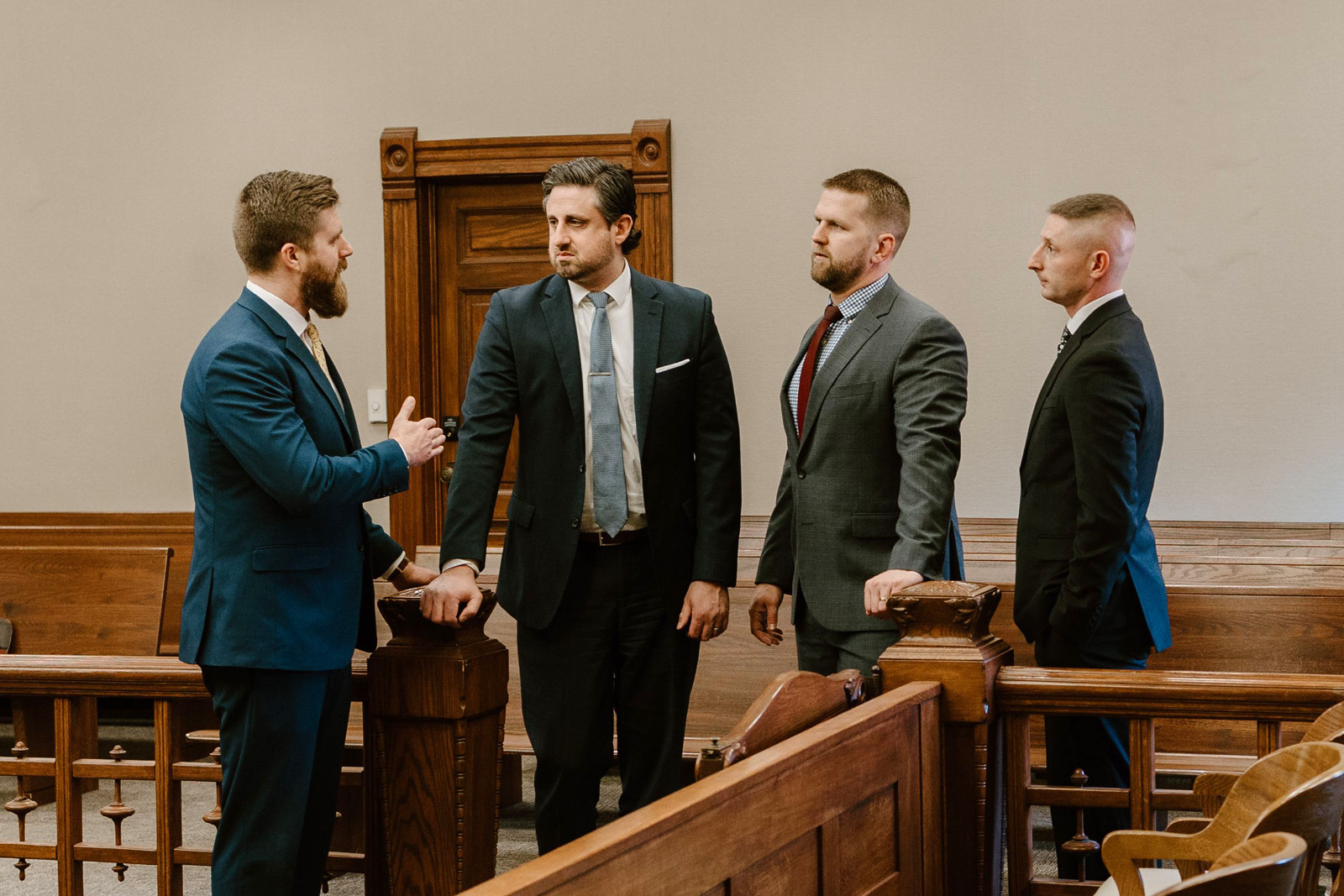
Because in Nebraska, once officers are called to a domestic dispute and find probable cause that an assault happened, they can arrest on the spot, with no warrant and no cooperation from the other person. In practice, someone usually leaves in handcuffs. Officers are trained to separate the parties, and the law gives them wide room to do it.
Nebraska does ask officers to pause before arresting both people. Under Neb. Rev. Stat. § 29-439, when two people accuse each other, the officer must weigh each complaint and identify the predominant aggressor rather than hauling in everyone. They look at injuries, the history between the parties, and whether one person acted in self-defense.
That sounds protective. In reality, the predominant aggressor call gets made in a few minutes, in a loud room, by an officer hearing two versions at once. People who were defending themselves got arrested. The person with the visible injury is sometimes the one who swung first. Specifically, that snap judgment becomes the State’s opening theory, and pulling it apart is part of the defense.
What Counts As Domestic Violence in Nebraska?
Nebraska’s domestic assault law turns on two things: who the other person is to you and what is alleged to have happened. Both are broader than most people assume.
In the relationship, an intimate partner includes a spouse or former spouse, the other parent of your child, and a current or former dating partner. A fight with a roommate or sibling may be charged as ordinary assault, but a romantic history almost always pulls the case into domestic territory, with the heavier consequences that follow.
On the conduct, the law covers causing bodily injury to an intimate partner and threatening one with imminent injury. Bodily injury can be minor. A grab, a shove, or a scratch can support a charge, and visible marks are not required for the State to proceed. That low threshold is why so many arguments that never felt criminal still end in an arrest.
What Are the Penalties for Domestic Assault in Nebraska?

Nebraska prosecutes these cases under its domestic assault statute, Neb. Rev. Stat. § 28-323, which sets three degrees. Third-degree domestic assault covers causing bodily injury to an intimate partner or threatening imminent injury. A first offense is a Class I misdemeanor, carrying up to one year in jail and a fine of up to $1,000.
The misdemeanor label is misleading because the charge climbs fast with history. One prior conviction turns a new third-degree charge into a Class IIIA felony, punishable by up to three years in prison plus 18 months of post-release supervision. Two or more priors make it a Class IIA felony, which carries up to 20 years.
Second-degree domestic assault involves a dangerous instrument or recklessly causing serious injury with one, and is a Class IIIA felony on its own. First-degree domestic assault, intentionally causing serious bodily injury, is the most serious form and carries the steepest exposure under the statute.
The line between a misdemeanor and a felony here can be a single prior conviction. Before you explain anything to anyone, call (531) 249-5534.
The No-Contact Order That Locks You out of Your Own Home
Here is the consequence almost no one sees coming. After a domestic assault arrest, the court routinely imposes a no-contact order as a condition of release. It can bar you from your house, from calling your kids, and from any contact with the person who accused you, sometimes for the entire length of the case.
That means one accusation can put you on a friend’s couch for months, still paying for a home you cannot enter, while the other party stays in it. The order applies before any finding of guilt. It is one of the most disruptive parts of a domestic case, and it is also one of the most negotiable.
A defense attorney can ask the court to modify that order, especially where shared children, housing, or finances are involved. Sometimes contact can run through a third party or be limited to parenting logistics. The first step is getting in front of the judge with a concrete alternative, not waiting and hoping it softens on its own.
What Should You Do in the First 48 Hours?
The first two days set the tone for the whole case. A few choices protect you, and a few common instincts make things worse.
Do not contact the person who accused you, even if they call, text, or show up wanting to talk. If a no-contact order is in place, answering can become a brand-new criminal charge, and prosecutors do file those. The other person reaching out first does not make your reply legal. Route everything through your lawyer.
Then preserve what tells your side. Save texts, photos, call logs, and the names of anyone who saw the argument or what followed it. Memories fade, and phones get wiped, so capture it now. At the same time, stay off social media about the case because anything you post can be screenshotted and handed to the prosecutor.
Finally, get a lawyer in place before your arraignment, not after. The earliest hearings set bond conditions, the no-contact order, and sometimes a protection order, and the decisions made there are far easier to shape than to undo later.
The early moves are the ones you cannot take back. Call (531) 249-5534 before the first hearing.
Do I Need a Lawyer for a Protection Order in Lincoln?
Often yes, because a protection order is a second, separate case running alongside the criminal one, and it can damage you in ways the criminal charge cannot. In Lancaster County, it is filed with the District Court clerk, and a judge can grant it ex parte, meaning before you have said a word.
Once the Lancaster County Sheriff serves you, a clock starts. Under Nebraska’s process, you have ten days from service to request a hearing. Miss that window, and the order can stand for a full year without you ever telling your side. Request it, and the judge sets a hearing where both people appear and put on evidence.
This is where many people quietly hurt themselves. They ignore the paperwork, assume it is folded into the criminal case, or walk into the hearing alone against a petitioner who brought a lawyer. A protection order on your record can surface in custody disputes, background checks, and job screenings for years. Contesting it on time, with evidence, is the move that protects you.
The order also carries its own criminal weight once it is in place. Violating a Nebraska protection order is a Class I misdemeanor for a first offense and a Class IV felony after that, and the State can charge you for any new conduct during the violation on top of that. A single frustrated text to the wrong person can turn one case into two.
Served with a protection order in Lincoln? The ten-day clock is already running. Call (531) 249-5534 today.
The Consequences That Outlast the Case: Guns and Children
A domestic violence conviction reaches into two areas that often matter to clients more than jail does: firearms and children.
On firearms, Nebraska and federal law do not line up, and the gap traps people. A misdemeanor domestic assault conviction permanently strips your firearm rights under state law.
Additionally, federal law, through the Lautenberg Amendment, imposes a strict lifetime ban for a misdemeanor crime of domestic violence that does not quietly switch off. People assume the state timeline is the whole story, and find out otherwise. Possessing a gun in violation of these rules is a Class I felony in Nebraska.
A protection order can cost you your firearms, too. Federal law bars gun possession by many people subject to domestic abuse protection orders, and the U.S. Supreme Court recently upheld that rule. For anyone whose job or livelihood depends on carrying a firearm, this is not a footnote.
On children, a domestic violence finding follows you into custody court. Nebraska’s Parenting Act requires judges to build protections into a parenting plan when intimate partner abuse is found, which can mean supervised visits, reduced parenting time, or a steeper climb to joint custody. In other words, what happens in the criminal case can quietly decide what happens with your kids.
The fallout spreads further still. A domestic violence record can surface in job and housing applications, threaten professional licenses, and create serious immigration consequences for non-citizens. That is reason enough to treat even a misdemeanor charge as something worth fighting.
If your firearms or your custody arrangement are on the line, the defense has to account for both. Call (531) 249-5534.
How Domestic Violence Cases Are Actually Defended in Lincoln
Two things make Lincoln cases harder than people expect, and both shape the defense.
First, Lancaster County prosecutes these charges aggressively. The County Attorney runs a dedicated Domestic Violence Prosecution Division, a specialized team built to pursue these cases and to keep them moving even when the accuser later wants out. A common misconception is that the alleged victim controls the case. They do not. The State decides whether to prosecute, and in Lincoln, it frequently does.
Second, diversion is usually off the table. For many first-time charges in Lancaster County, prosecutors offer diversion that ends in dismissal. Domestic assault generally sits on the excluded list. That removes the easy exit other defendants get and puts the weight back on the actual defense: the evidence, the witnesses, and the credibility of the accusation.
So the defense gets specific. It presses on the predominant aggressor decision, on injuries that fit self-defense, on 911 audio and body camera footage that contradict the written report, on inconsistent statements, and on motive to fabricate. None of that requires calling the accuser a liar. Fear, anger, and memory distort accounts on their own.
A real defense starts with the evidence, not an apology. Call (531) 249-5534 to talk through yours.
What if the Accusation Is False or Exaggerated?
It happens more than the system likes to admit, and it clusters around breakups, divorces, and custody fights. An accusation made in that moment can shift who controls the house, who keeps the children, and who looks like the victim in a pending family case. Courts know the dynamic exists.
Proving it takes more than insisting you are innocent. It takes timing, records, and motive. When was the allegation made in relation to a custody filing? Do earlier messages show a calm relationship that turned only once something was at stake? Did the physical evidence match the account, or contradict it?
Accusers also recant, sometimes because the first version was overstated and sometimes because they want the family back together. In Lincoln, a recantation does not automatically end the case, because the specialized prosecution unit can move forward without the accuser. Even so, how it is documented and presented can change where the case lands.
Frequently Asked Questions
Can the charges be dropped if my partner does not want to press them?
Not on their own. In Lancaster County, the County Attorney decides whether to prosecute, not the accuser, and the specialized domestic violence unit often proceeds anyway using 911 calls, photos, and officer testimony. An attorney can still influence that decision, but simply waiting for the other person to drop it rarely works.
Will a domestic violence conviction take away my gun rights?
Likely yes. A misdemeanor conviction permanently ends your firearm rights under Nebraska law, and a separate federal ban under the Lautenberg Amendment can last far longer. A felony conviction or a qualifying protection order can also bar possession. Violating any of these bans is itself a felony in Nebraska.
I was the one defending myself. Why was I arrested?
Because officers make a fast predominant aggressor call under Neb. Rev. Stat. § 29-439, often before the full picture is clear. The visible injury does not always belong to the person who started it. Self-defense is a recognized defense in Nebraska, and the early facts can be gathered to show it.
How long does a no-contact order last?
A no-contact order imposed as a release condition can run the length of the criminal case, which may be months. It can keep you out of your home and away from your children before any conviction. A lawyer can ask the court to modify it, especially where children and housing are at stake.
Should I just explain my side to the police?
No. Officers are gathering evidence, and in a domestic case your explanation usually becomes part of the State’s file. You can decline to answer and ask for a lawyer without admitting anything. What feels like clearing things up often does the opposite. Call (531) 249-5534 before you talk.
Do I have to move out if there is a no-contact order?
If the order names your shared home or the other person still lives there, then, in practice, yes, until the court changes it. That is exactly why asking the judge to modify the order early matters. A lawyer can request terms that address housing and parenting instead of a blanket bar on contact.
Can a domestic violence charge come off my record later?
Sometimes. If the case ends without a conviction, you may be able to seal the arrest record, and some convictions later qualify for a set-aside under Nebraska law. The path depends on how the case is resolved, which is one more reason the outcome you reach now matters for years afterward.

Why Liberty Law Group
We defend domestic violence cases throughout Lincoln and Lancaster County, and we work both halves at once: the criminal charge in county or district court, and the protection order hearing beside it. We are licensed in Nebraska and Iowa and appear in state and federal court.
We represent people facing serious accusations without treating them as the accusation. A domestic case is often the worst week of someone’s life colliding with a system that has already moved against them. Our job is to slow that down, hold the State to its proof, and protect what you still have.
Talk it through with a Lincoln domestic violence attorney. Call (531) 249-5534. The first conversation is free and stays between us.
Liberty Law Group – Lincoln Office
1201 O St #101,
Lincoln, NE 68508
P: (402) 645-0031